The differential equation presented in the previous posts

appears in quantum mechanics when a particle is subjected to a linear potential. The time-independent Schrödinger equation is

Consider a linear potential of the form

where 

Rearranging the terms gives

We introduce the turning point 


The equation then becomes

Introducing the dimensionless variable

we finally obtain

Thus, the equation
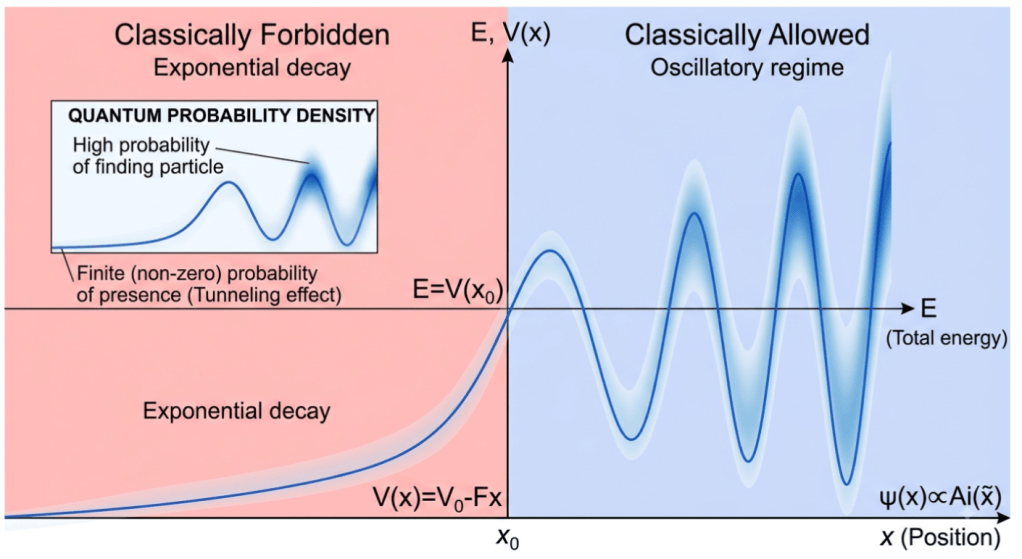
is, after a suitable rescaling and translation of the independent variable, an Airy equation. It describes, in particular, the behavior of a quantum wavefunction near a turning point, i.e. a position where

In a region where 



Leave a Reply