The differential equation presented in the previous posts
appears in quantum mechanics when a particle is subjected to a linear potential. The time-independent Schrödinger equation is
Consider a linear potential of the form
where is a constant force. The Schrödinger equation then becomes
Rearranging the terms gives
We introduce the turning point (in quantum mechanics, it marks the transition between an oscillatory (classically allowed) region and an exponentially decaying (classically forbidden) region) defined by
The equation then becomes
Introducing the dimensionless variable
we finally obtain
Thus, the equation
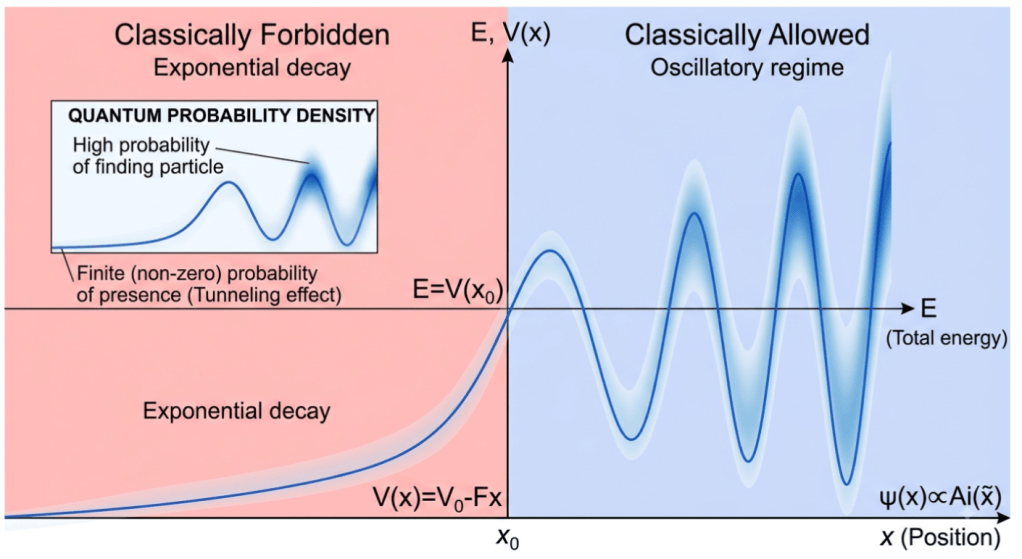
is, after a suitable rescaling and translation of the independent variable, an Airy equation. It describes, in particular, the behavior of a quantum wavefunction near a turning point, i.e. a position where
In a region where , the solution is oscillatory, whereas in a region where , it exhibits exponential behavior. The Airy function provides the transition between these two regimes (see fig. below).
In physics, most problems—from the anharmonic oscillator to Quantum Electrodynamics (QED)— cannot be solved exactly. We rely on Perturbation Theory, expanding the solution in powers of a small coupling constant (often denoted λ or α).
A classic example is the quantum anharmonic oscillator, where the Hamiltonian is
(with the quartic term treated as a small perturbation λ ≪ 1). Another famous case is QED, where the fine-structure constant α ≈ 1/137 serves as the small parameter for expanding processes involving electrons and photons.
The challenge? These perturbative expansions are almost always asymptotic series with a null radius of convergence. The coefficients typically grow factorially as (or even faster), making the series eventually diverge regardless of how small the coupling constant is.
For instance, in the anharmonic oscillator, the perturbative corrections to the energy levels involve terms whose coefficients grow like , leading to a divergent series for any nonzero λ. Similarly, in QED, the perturbative series for quantities like the electron’s anomalous magnetic moment (g−2) is asymptotic: it gives spectacular agreement with experiment up to high orders, but diverges if pushed too far.
This is where our journey pays off. By applying Borel resummation and Padé approximants to these divergent series, we can extract non-perturbative information and obtain remarkably accurate physical predictions. In quantum field theory, Borel summation helps recover meaningful results from perturbative expansions (for example, in certain Euclidean field theories or by handling contributions from instantons and renormalons). Padé approximants are routinely used to accelerate convergence and estimate the behavior of series in QCD and other models.
In our upcoming posts, we will see how this mathematical framework becomes the essential language of modern theoretical physics.
After several months of exploring various summation and acceleration methods, it is time to synthesize these tools before we apply them to one of their most important domains: Perturbation Theory.
When a power series has a small or even zero radius of convergence, or converges too slowly to be numerically useful, we require more than standard arithmetic. Here is a recap of the methods we have covered and how they bridge the gap between formal series and numerical values.
Summation Methods: Taming Divergence
Borel and Borel–Écalle: By using the Borel transform, we transform factorially growing coefficients into a convergent series in the Borel plane. The Borel–Écalle framework further allows us to handle singularities via resurgence theory, providing a unique “resummed” value even for non-Borel-summable series.
Euler and Zeta summation: These methods assign finite values to divergent sums by analytic continuation. While Euler summation is ideal for alternating series, Zeta summation provides a powerful way to handle the infinite sums that frequently appear in quantum vacuum energy calculations.
Generic summation: Beyond these classical approaches, we have also explored the idea of generic summation, which provides a unifying framework for assigning values to divergent or slowly convergent series.
Acceleration Techniques: Enhancing Convergence
Shanks Transformation and Padé Approximants: These nonlinear transformations (often related to continued fractions) excel at capturing the behavior of functions beyond their radius of convergence, particularly when poles are present.
Richardson Extrapolation: A fundamental tool for numerical analysis that cancels out the leading error terms, allowing us to estimate the limit of a sequence Sn with much higher precision from only a few terms.
An important consistency check underlies all these techniques: whenever different summation or acceleration methods apply to the same series, they agree on a common value. This convergence of independent approaches is not accidental, it reflects the fact that these methods capture an underlying analytic object beyond the formal series itself. When they work, they do not merely assign a value: they reveal a coherent extension of the function that the original divergent expansion was hinting at.
We used Padé approximants to compute the ground state energy . Now we aim to calculate using Borel summation. The (formal) Borel sum is given by
Using the first three coefficients of the perturbative series, the truncated Borel transform is approximated by
so the truncated Borel sum writes
since
This doesn’t really seem like progress, since the first terms of the Borel sum are identical to those of the perturbative expansion. The perturbative expansion above has coefficients that grow factorially. Bender and Wu showed that for large ,
Since
thus the series diverges for all .
Borel summation improves convergence by dividing out this factorial growth.
In summary, even with just a few terms, Borel summation correctly recovers the perturbative results for the anharmonic oscillator then It turns the divergent series into a well-defined and useful result.
We would like to illustrate the use of Padé approximants in the context of the anharmonic oscillator. A harmonic oscillator is an oscillating system that experiences a restoring force. Anharmonicity is the deviation of a system from being a harmonic oscillator. The anharmonic oscillator is described by the following differential equation:
This differential equation is very hard to solve exactly. In order to obtain an approximate solution, we can use perturbation theory. By inserting a small dimensionless parameter , the equation becomes:
If we are interested in the energy levels, the basic idea is to write as a geometric series. For the ground state we write:
The solution is a divergent perturbation series (C.M. Bender and T.T. Wu, Phys. Rev. 184, 1969):
It’s therefore interesting to note that in order to solve a very difficult differential equation, we can use perturbation theory. In the case of the anharmonic oscillator, the perturbative series is divergent. Using Padé approximants, we can make use of a divergent perturbative series and approximate the exact answer arbitrarily.




 is correct:


 gives the first-order perturbative approximation to the corresponding solution of the Airy equation.

 ):
):
 as:
as:


 typically grow factorially as
  (or even faster), making the series eventually diverge regardless of how small the coupling constant is.
 has a small or even zero radius of convergence, or converges too slowly to be numerically useful, we require more than standard arithmetic. Here is a recap of the methods we have covered and how they bridge the gap between formal series and numerical values.
 . Now we aim to calculate


 above has coefficients that grow factorially. Bender and Wu showed that for large
  ,
,

 .
.

 as a geometric series. For the ground state
  we write:
 approximant of


 and the exact solution is 1.3924.
 is:
is:
 Approximaths