If we give the value 1 for the series from the previous post and draw up a table of the values of the integral as a function of , we can see that the values first converge towards the exact value and then move away from it (see table below). This reminds us of the “astronomers’ series” described by H. Poincaré. We also note that we cannot approach the exact value with arbitrary precision using this method.
n
Approximation
Error
0
1
0.4036
1
0
-0.5963
2
2
1.4037
3
-4
-4.5963
4
20
19.4037
5
-100
-100.5963
Given such a series, a natural question is: Up to what value of should we sum in order to get as close as possible to the exact value ? In order to determine the ideal value of , we must first note the following facts concerning the remainder of the series above:
Defining (), we have:
We observe that:
Therefore:
Based on the above calculations, we can now define a lower bound () and an upper bound () for the error made when evaluating the Stieltjes integral using the sum derived above.
For , we have and . The approximation, error, and corresponding upper and lower bounds for the error are shown for in the table below. In this table, we can clearly see that the approximations are getting worse and worse, while the lower and upper bounds are getting larger and larger. This makes the perturbative method, as implemented in this example, unattractive.
In this post we would like to illustrate the calculation of an integral using perturbation techniques. We would like to calculate the following Stieltjes integral:
This integral can be evaluated exactly (I = 0.5963), but we’ll use perturbation techniques to compare the results obtained using these approximation techniques with the exactly calculated value. In order to do so, we will insert the parameter as follows:
For we have = 1. This is the solution to the unperturbed problem. We observe that:
Defining and using in the formula above we obtain:
The differential equation presented in the previous posts
appears in quantum mechanics when a particle is subjected to a linear potential. The time-independent Schrödinger equation is
Consider a linear potential of the form
where is a constant force. The Schrödinger equation then becomes
Rearranging the terms gives
We introduce the turning point (in quantum mechanics, it marks the transition between an oscillatory (classically allowed) region and an exponentially decaying (classically forbidden) region) defined by
The equation then becomes
Introducing the dimensionless variable
we finally obtain
Thus, the equation
is, after a suitable rescaling and translation of the independent variable, an Airy equation. It describes, in particular, the behavior of a quantum wavefunction near a turning point, i.e. a position where
In a region where , the solution is oscillatory, whereas in a region where , it exhibits exponential behavior. The Airy function provides the transition between these two regimes (see fig. below).


 we have
  = 1. This is the solution to the unperturbed problem. We observe that:


 and using
  in the formula above we obtain:


 . Finally we have:


 is a constant force. The Schrödinger equation then becomes

 (in quantum mechanics, it marks the transition between an oscillatory (classically allowed) region and an exponentially decaying (classically forbidden) region) defined by


 , the solution is oscillatory, whereas in a region where
  , it exhibits exponential behavior. The Airy function provides the transition between these two regimes (see fig. below).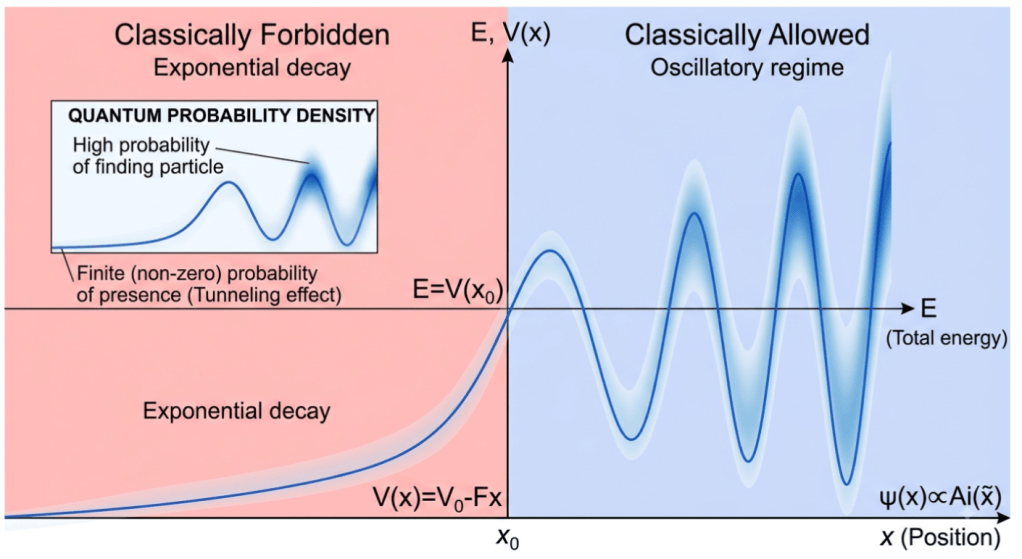


 is correct:


