The previous post illustrates the general strategy: the admissible scalings are obtained from the intersections of the affine exponent functions. In this post, we explain why this construction works. Consider a perturbed polynomial of the form
After the scaling
each monomial becomes
Thus every monomial defines an affine function
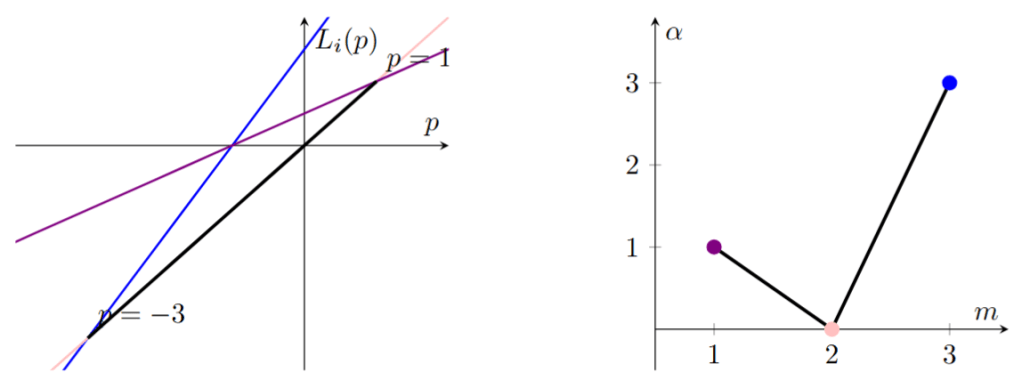
The exponents of  are therefore completely described by the family of affine functions
The key observation is that, as  , the smallest exponent dominates all the others. Indeed, if
then
Consequently, for a fixed value of  , only the monomials whose exponent is minimal contribute to the dominant part of the polynomial.
Now suppose that one affine function lies strictly below all the others. Then a single monomial dominates, and the limit polynomial consists of only one term.
The interesting situation occurs when two affine functions intersect and their common value is the minimum among all the exponents. At such a point,
so two monomials have exactly the same asymptotic order. After normalization, both survive in the limit polynomial, producing a non-trivial dominant part.
Not every intersection is relevant. Two affine functions may intersect while another affine function remains strictly below them. In that case, the common exponent is not minimal, and the corresponding scaling does not contribute to the dominant polynomial.
Therefore, the admissible scalings are obtained precisely from the intersection points where the common exponent is minimal.
Geometrically, this means that the admissible scalings correspond to the corners of the lower envelope of the affine functions (see previous post). This simple geometric picture explains why the graph of the exponents completely determines the regularization process.


 , we associate it with the point
 plane. The Newton polygon is defined as the lower convex hull of these points. Its edges contain exactly the information needed to determine the admissible scalings. Indeed, if an edge joins the points




 ,
,  , and
, and  . Their intersection points determine the values of
 defined as follows:


 . Therefore, we may write
 is the dominant part of
  regularizes the perturbed polynomial
  .
.
 is the intersection of the lines
  , the minimum exponent is attained simultaneously by two monomials.


 admit power-series expansions in
  ‘s are rational numbers and
  ‘s,
‘s,  ‘s are constants.


 is a continuous function near zero. For convenience, we simply write
  . If the theorem holds, the polynomial above becomes:

 and have:
 is a root of
 to determine the leading-order behavior:

 to hold, the minimal value of the set
  must be exactly
  , and this minimum must be shared by at least two distinct exponents. These identical minimal exponents define the dominant terms of
