Regularize I

We will now present (without justification) a method for regularizing a singular problem involving a polynomial. We want to find the roots of :

\displaystyle P(x) = x^6 - x^4 - x^3 + 8

We decide to perturb the above polynomial as follows:

\displaystyle P_{\epsilon}(x) = \epsilon^2 x^6 - \epsilon x^4 - x^3 + 8

For \epsilon = 0 we have:

\displaystyle P_{\epsilon= 0}(x) = -x^3 + 8

This polynomial has three roots. We have a singular problem since the original polynomial has six roots.

We can try to fix the problem using a change of variable:

\displaystyle x := \epsilon^p w
\displaystyle P_{\epsilon}(\epsilon^p w) = \epsilon^2 (\epsilon^p w)^6 - \epsilon (\epsilon^p w)^4 - (\epsilon^p w)^3 + 8
\displaystyle = \epsilon^2 (\epsilon^{6p} w^6) - \epsilon (\epsilon^{4p} w^4) - (\epsilon^{3p} w^3) + 8
\displaystyle = \epsilon^{6p+2} w^6 -  \epsilon^{4p+1} w^4 - \epsilon^{3p} w^3 + 8

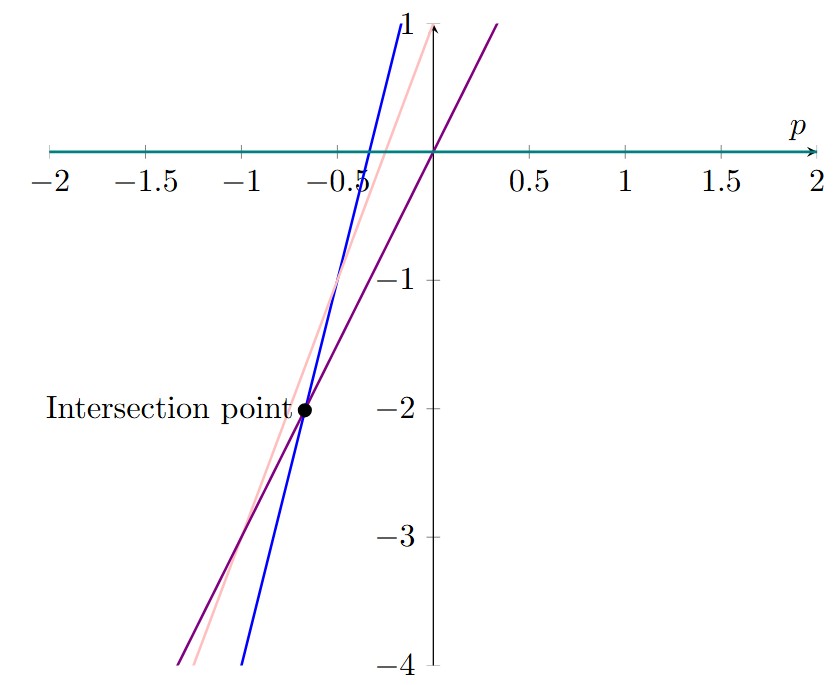
Now we collect the exponents of \epsilon: (6p+2, 4p+1, 3p, 0) and plot them in a graph as a function of p (see figure below). If we think of the lines on the graph as delimiting a figure in the plane, we can select the vertex of this figure with the largest p value and the smallest f(p) value. In our case, the point corresponding to this criterion is the point of intersection of the lines 6p+2 and 3p. We thus obtain the point of intersection with coordinates (-2/3, -2).

We will call the coordinates of the intersection point p_j and m_j respectively.

Now calculate:

\displaystyle \epsilon^{-m_j} P_{\epsilon}(\epsilon^{p_j} w) = \epsilon^{2} P_{\epsilon}(\epsilon^{-\frac{2}{3}} w)
\displaystyle = \epsilon^2 (\epsilon^{6(-\frac{2}{3})+2} w^6 -  \epsilon^{4(-\frac{2}{3})+1} w^4 - \epsilon^{3(-\frac{2}{3})} w^3 + 8)
\displaystyle = \epsilon^2 (\epsilon^{-2} w^6 - \epsilon^{-\frac{5}{3}} w^4 - \epsilon^{-2} w^3 + 8)
\displaystyle =  w^6 - \epsilon^{\frac{1}{3}} w^4 - w^3 + 8 \epsilon^2

This is now a regular problem since the new polynomial:

\displaystyle P(w) = w^6 - w^3

has 6 roots.

Using the procedure above we have regularized a singular problem involving a polynomial using the following sequence:

\displaystyle P(x) \to P_{\epsilon}(x) \to P_{\epsilon}(\epsilon^p w) \to \epsilon^{-m_j} P_{\epsilon}(\epsilon^{p_j} w)

Comments

Leave a comment