Illustration of a singular problem

Illustration of a singular problem:

\displaystyle x^2-2x +1 = 0 \quad \text{Problem}
\displaystyle \epsilon x^2-2x +1 = 0 \quad \text{Insert }\epsilon

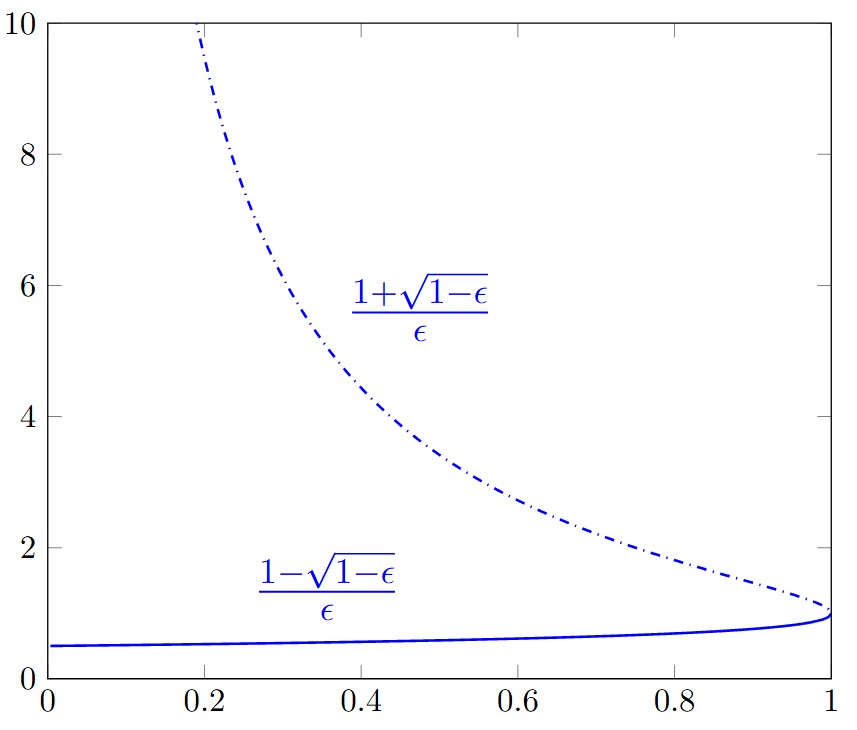
The solutions to the perturbed problem are (see figure below):

\displaystyle x_1(\epsilon) = \frac{1+ \sqrt{1-\epsilon}}{\epsilon}
\displaystyle x_2(\epsilon) = \frac{1- \sqrt{1-\epsilon}}{\epsilon}

While one of the roots approaches \frac{1}{2} as \epsilon \to 0, the other goes to infinity. This is a manifestation of a singular behaviour. The problems above illustrate the importance of setting \epsilon to a right position.

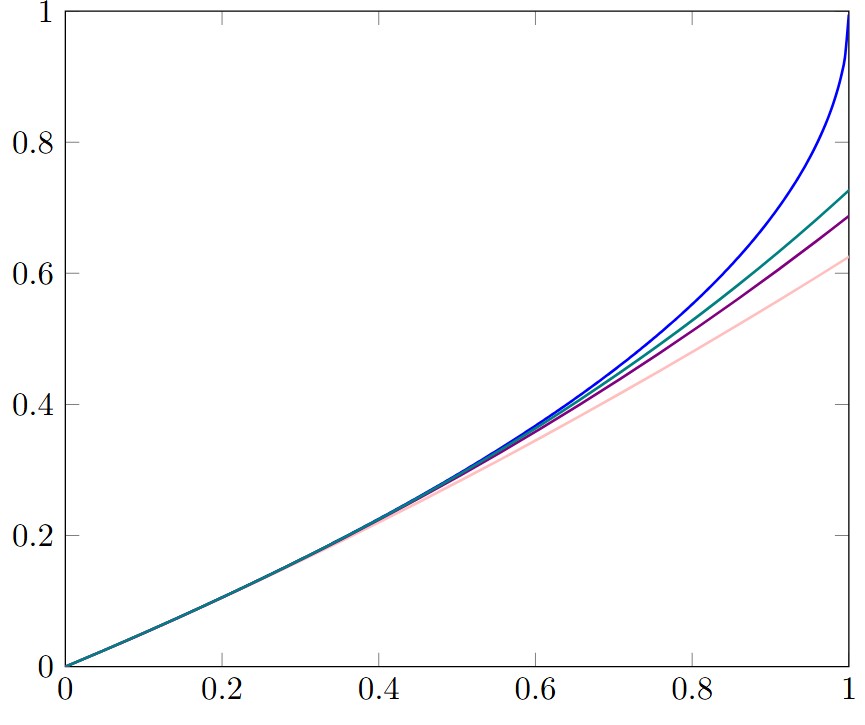
A solution of the regular problem x^2-2x +\epsilon = 0 is x_1(\epsilon) = 1 - \sqrt{1- \epsilon} . We would like to calculate the corresponding perturbative series.

Using:

\displaystyle (a+b)^n = \sum_{k=0}^{\infty} {n\choose k} a^{n-k}b^{k}
\displaystyle = a^n + n a^{n-1}b + \frac{n(n-1)}{2} a^{n-2}b^{2}+...+ \frac{n(n-1)\cdots(n-k+1)}{k!} a^{n-k}b^k +...

We would like to find the perturbative series corresponding to:

\displaystyle \sqrt{1-\epsilon} = (1-\epsilon)^{1/2}

with a=1, b = -\epsilon, n = \frac{1}{2} therefore:

\displaystyle \sqrt{1-\epsilon} = 1 - \frac{1}{2}\epsilon - \frac{1}{8}\epsilon^2 - ...
\displaystyle 1- \sqrt{1-\epsilon} = \frac{1}{2}\epsilon + \frac{1}{8}\epsilon^2 + ...

Here are the first series and their corresponding graphs:

\displaystyle s_2 = \frac{1}{2} \epsilon + \frac{1}{8} \epsilon^2
\displaystyle s_3 =\frac{1}{2} \epsilon + \frac{1}{8} \epsilon^2 + \frac{1}{16} \epsilon^3
\displaystyle s_4 = \frac{1}{2} \epsilon + \frac{1}{8} \epsilon^2 + \frac{1}{16} \epsilon^3 + \frac{5}{128} \epsilon^4

Comments

Leave a comment