Asymptotics: Introduction III

A sequence of functions \{\phi_j(x)\} where \phi_j : \mathbb{R} \setminus \{0\} \to \mathbb{R} is an asymptotic sequence as x \to x_0 if for each j = 1,2,3,\dots we have

\displaystyle \phi_{j+1}(x) \ll \phi_j(x)

\phi_j is also called a ‘gauge function’. For example \frac{1}{x} \gg \frac{1}{x^2} \gg \frac{1}{x^3} \gg \dots as x \to \infty.

f(x) has the asymptotic expansion a_1\phi_1(x) + a_2\phi_2(x) + a_3\phi_3(x) + \dots as x \to x_0 if:

  • \{\phi_j(x)\} is an asymptotic sequence
  • R_n(x) = f(x) - \sum_{j=1}^{n} a_j \phi_j(x) \ll \phi_n(x)

In other words if the remainder R_n(x) is much smaller (a ‘little O’) than the last term included in the sequence. In order to calculate the integral presented in this post we derived the following series:

\displaystyle \frac{0!}{x} - \frac{1!}{x^2} + \frac{2!}{x^3} - \dots

We can verify that the gauge functions

\displaystyle \frac{1}{x} \gg \frac{1}{x^2} \gg \frac{1}{x^3} \gg \dots

form an asymptotic sequence as x \to \infty and that the remainder R_n(x) is smaller than the latest term included in the sequence since

\displaystyle R_n(x) = o\left(\frac{1}{x^n}\right) \quad \text{and} \quad R_n(x) = \mathcal{O}\left(\frac{n!}{x^{n+1}}\right)

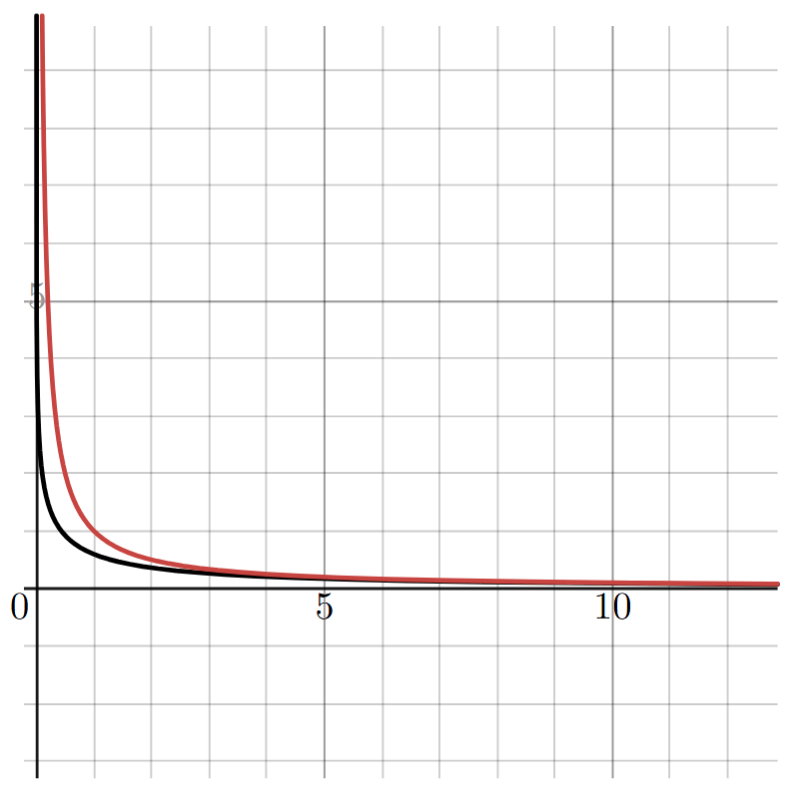
It is interesting to note from a practical point of view that the first term of the asymptotic series 1/x gives a reasonable approximation (according to the criteria of the scientific domain in which such an approximation is applied) to the exact value of the integral even for small value of x. We have replaced a complicated exponential integral with a simple function (1/x) and have acceptable approximation.

Comparison between the exact value of the integral I(x) (black line) and the first term 1/x of its asymptotic series for large x (red line).

Comments

Leave a Reply