Regular Problem II

Illustration of another regular problem:

\displaystyle x^2-2x -1 = 0 \quad \text{Problem}
\displaystyle x^2-2\epsilon x-1=0 \quad \text{Insert }\epsilon

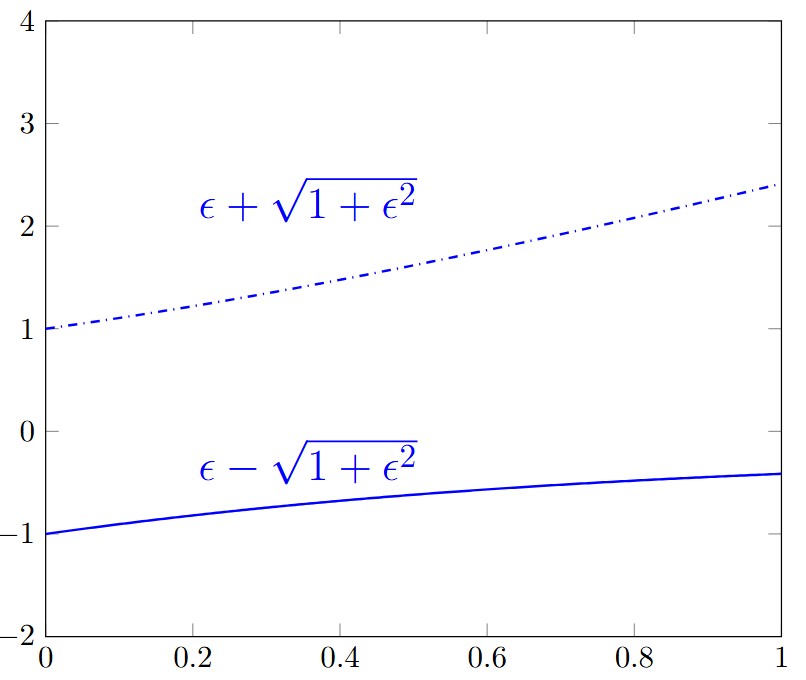
The solutions to the perturbed problem are (see figure below):

\displaystyle x_1(\epsilon) = \frac{2\epsilon + \sqrt{4 \epsilon^2 + 4}}{2} = \epsilon + \sqrt{1 + \epsilon^2}
\displaystyle x_2(\epsilon) = \frac{2\epsilon - \sqrt{4 \epsilon^2 + 4}}{2} = \epsilon - \sqrt{1 + \epsilon^2}

The figure above shows solutions of the problem x^2-2\epsilon x-1 = 0 using perturbation theory. For \epsilon =0 the solutions are -1 and 1 and for \epsilon =1 the solutions are exactly 1+\sqrt{2} and 1-\sqrt{2}.

\displaystyle x_1(\epsilon) = 1 + \epsilon + \frac{1}{2}\epsilon^2 - \frac{1}{8}\epsilon^4 + \frac{1}{16}\epsilon^6 - \frac{5}{128}\epsilon^8 + O(\epsilon^{10})
\displaystyle x_2(\epsilon) = -1 + \epsilon - \frac{1}{2}\epsilon^2 + \frac{1}{8}\epsilon^4 - \frac{1}{16}\epsilon^6 + \frac{5}{128}\epsilon^8 + O(\epsilon^{10})

Setting \epsilon = 1 :

\displaystyle x_1(1) \approx 2 + \frac{1}{2} - \frac{1}{8} + \frac{1}{16} - \frac{5}{128} = 2.3984375
\displaystyle x_2(1) \approx 0 - \frac{1}{2} + \frac{1}{8} - \frac{1}{16} + \frac{5}{128} = -0.3984375

This simple example clearly illustrates the application of regular perturbation theory to a quadratic equation, showing how the solutions vary continuously with the perturbation parameter \epsilon .

Comments

Leave a comment