Regular Problem I

In perturbation theory we distinguish regular and singular problems. In this section we aim to solve the original regular problem:

\displaystyle x^2 - 2 = 0 \quad \text{Original problem}
\displaystyle x^2 - (1 + \epsilon) = 0 \quad \text{Insert epsilon}

The solutions are:

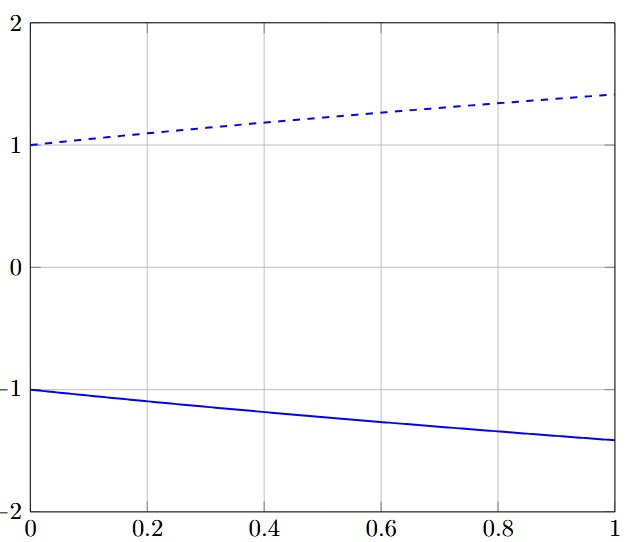
\displaystyle x_1(\epsilon) = -\sqrt{1+\epsilon}
\displaystyle x_2(\epsilon) = \sqrt{1+\epsilon}

At \epsilon=0 the problem is solvable analytically:

\displaystyle x_1 = -1, \quad x_2 = 1

At \epsilon=1 we recover the solution of the original problem:

\displaystyle x_1 = -\sqrt{2}, \quad x_2 = \sqrt{2}

Figure. Regular problem: x^2-(1+\epsilon)=0 connecting x^2-1=0 to x^2-2=0.

Characteristics of a regular perturbation problem:

  • The solution depends smoothly on ε.
  • The deformation from ε=0 to ε=1 is continuous.
  • The problem at ε=0 is simple and solvable analytically.
  • The original problem is recovered exactly at ε=1.
  • No singularities or discontinuities appear.
  • The solution admits a regular power-series expansion in ε.

We treat \epsilon as a parameter to track the perturbation. The solution x_2(\epsilon) = \sqrt{1+\epsilon} can be expressed as a Taylor series around the simple problem (\epsilon = 0):

\displaystyle x_2(\epsilon) = 1 + \frac{1}{2}\epsilon - \frac{1}{8}\epsilon^2 + \frac{1}{16}\epsilon^3 - \frac{5}{128}\epsilon^4 + \dots

The original problem x^2 - 2 = 0 is recovered by evaluating this series at \epsilon = 1. The smooth dependence on the parameter allows us to reach the target solution. For \epsilon=1, the first few terms give:

\displaystyle x_2(1) \approx 1 + 0.5 - 0.125 + 0.0625 - 0.039 = 1.3985

which is already a good approximation \sqrt{2} \approx 1.4142.

This example illustrates a regular homotopy connecting the simple problem x^2 - 1 = 0 to the target problem x^2 - 2 = 0.

Comments

Leave a comment