Let’s imagine we don’t have a calculating machine or computer and we want to calculate the value of the root of 2 using perturbation theory. Remember that we always insert epsilon so that the problem is exactly solvable for epsilon equals zero. Here’s how we might proceed:


In this case, we keep only the powers of epsilon up to order two. We want to perform a perturbative calculation of order two.


Let us solve the same problem but this time we keep the powers of epsilon up to order three.


This suggests the following (using the double factorial notation):


We could use Euler’s summation to speed up the convergence of this series. We observe that perturbing the initial problem in this form:

is similar to finding the roots of the polynomial


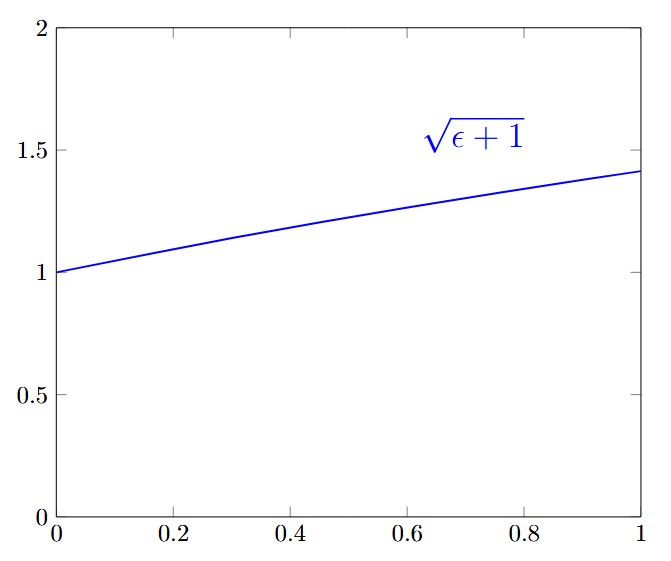
whose solution is (see figure below)

 Approximaths
Leave a comment