Perturbation Theory – Case Study 2

We would like to solve a very simple problem. This time we will set a power of \epsilon:

\displaystyle x - 2 = 0 \quad \text{Problem}
\displaystyle x - 2\epsilon^2 = 0 \quad \text{Insert }\epsilon^2
\displaystyle x = 0 \quad \text{Set }\epsilon^2 = 0
\displaystyle (a_0 + a_1 \epsilon + a_2 \epsilon^2 + \dots) - 2\epsilon^2 = 0 \quad \text{Insert }x_{\epsilon}
\displaystyle a_0 + a_1 \epsilon + (a_2 - 2)\epsilon^2 + \dots = 0 + 0 + 0 + \dots

By identifying coefficients of equal powers of \epsilon (uniqueness of power series expansion), we obtain:

\displaystyle \implies a_0 = 0,\ a_1 = 0,\ a_2 = 2,\ \dots
\displaystyle x_{\epsilon} = 0 + 0 + 2\epsilon^2 + \dots
\displaystyle x_{\epsilon} = 2\epsilon^2

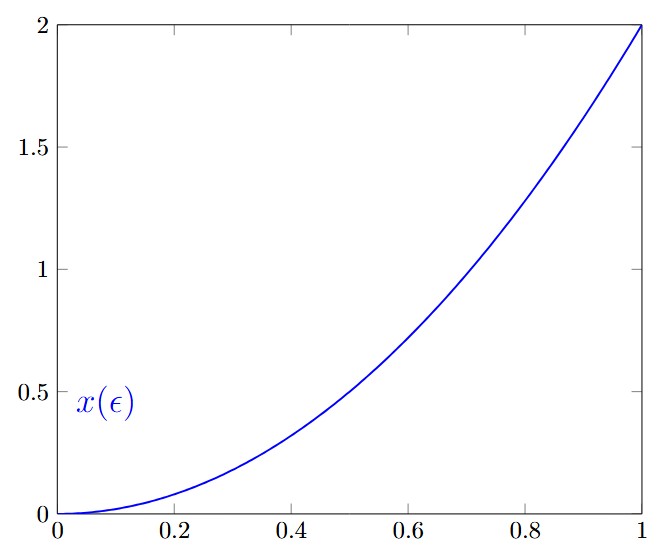
Evaluating the solution at \epsilon = 1 recovers the original problem and gives x = 2. In the figure below we visualize the solution of x - 2\epsilon^2 = 0 as a function of \epsilon.

For this very simple example, we essentially chose a placement of \epsilon such that the unperturbed problem (for \epsilon = 0) becomes trivial. We also have many choices for the power of \epsilon. In this example, the perturbation series terminates and yields the exact solution.

Comments

Leave a comment