Consider the archetypal divergent series
In a previous post we have seen the Borel summation of 
Step 1 – Ordinary Borel summation
The ordinary Borel summation fails for  the analytic continuation of
  has a simple pole at
  lying on the positive real axis. The ordinary Borel integral
therefore diverges for all (the pole blocks the integration path).
Step 2 – Borel–Écalle summation
Define the two lateral Borel transforms by deforming the contour slightly above (+) or below (-) the real axis:
The notation ∞e±i0 means that the upper limit of integration is taken to infinity along a ray that approaches the positive real axis from above (angle +0) or from below (angle −0). This slight contour deformation is necessary when the integrand has a singularity (here at t = 1/x) on the positive real axis itself, which would cause the ordinary Borel integral to be ill-defined.
These integrals exist, and
The Borel–Écalle summation is defined by
And in this case:
where  is the exponential integral function. Thus, despite the divergence of the original series and the failure of ordinary Borel summation due to the pole on the integration path, the Borel–Écalle median summation recovers the exact analytic continuation on the positive real axis.


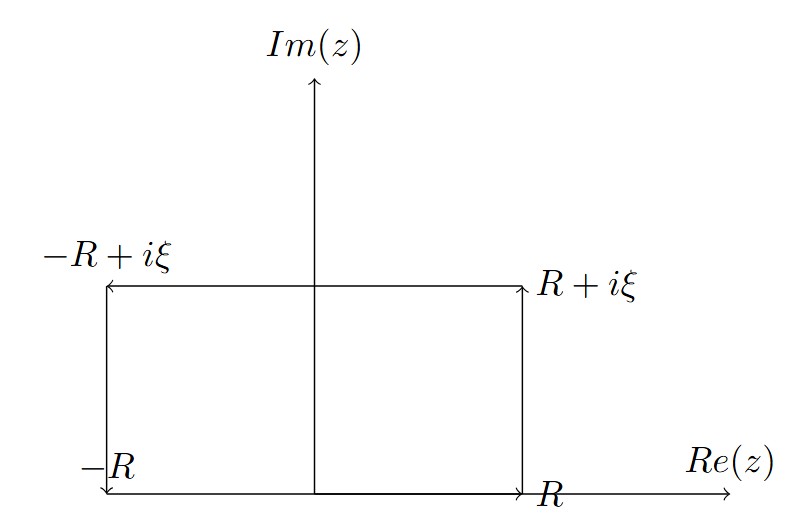


 as:
as:

 we should use the analytic continuation of the Zeta function.
 is defined as:
 . If the derivative exists in all points of a region of the complex-plan we say that f(z) is analytic in this region. If the function is analytic inside some circle of convergence
  it can be represented by the Taylor series:
 is the center of the circle
  in
in  the function can be represented by the Taylor series:


 . We would like to show that this function is equivalent to its Fourier transform
 :
:
 :
:

 . Now we aim to calculate


 above has coefficients that grow factorially. Bender and Wu showed that for large
  ,
,

 .
.


 Approximaths